


[ad_1]
NEW DELHI: Nearly two years after settling the vexed Hindu-Muslim litigation over the disputed Ayodhya land, the Supreme Court on Tuesday closed proceedings on a 31-year-old petition filed by Mohammed Aslam, aka Bhure, who had first sought status quo at the Babri-Masjid-Ram Janambhoomi site in 1991.
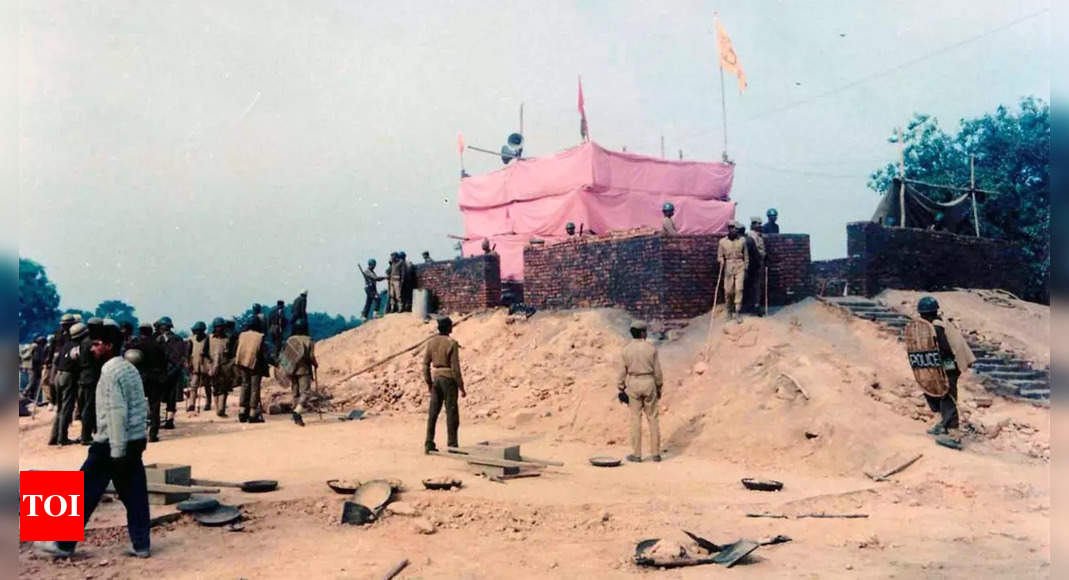
Bhure had filed the first petition challenging the acquisition of land around the disputed site by the Uttar Pradesh government in 1991, ostensibly for creating amenities for pilgrims to Ayodhya. The SC had ordered status quo on all construction activities at the site.
But, when this order was violated, and structures were allegedly raised on the acquired 68 acres of land, Bhure had filed a contempt petition against then Uttar Pradesh chief minister Kalyan Singh and others in 1992.
On October 24, 1994, on Bhure’s petition, the SC convicted Singh for contempt of court. It had said, “It is (a) unhappy (situation) that a leader of a political party and chief minister has to be convicted of an offence of contempt of court. But it has to be done to uphold the majesty of law.”
Bhure had also filed a petition in 2002 in the SC seeking status quo at the disputed site after Vishwa Hindu Parishad decided to hold a ‘Shila Pujan’ ceremony. The SC had agreed with the petitioner and granted status quo on all religious activities at the disputed site.
On Tuesday, Bhure’s long-standing counsel M M Kashyap informed a bench of Justices Sanjay K Kaul, A S Oka and Vikram Nath that the petitioner passed away in 2010 and that he needed to be substituted as petitioner for prosecuting the case. He also said that there is a need to reconstruct the 31-year-old files, which run into over 10,000 pages. But the bench said that after the November 9, 2019 judgment of the Constitution bench, deciding the 70-year-old title suits in favour of Hindus, nothing survived in the Ayodhya dispute.
Justice Kaul said, “I appreciate the argument that the petitions should have been listed for hearing earlier. But you cannot keep flogging a dead horse.”
Bhure had filed the first petition challenging the acquisition of land around the disputed site by the Uttar Pradesh government in 1991, ostensibly for creating amenities for pilgrims to Ayodhya. The SC had ordered status quo on all construction activities at the site.
But, when this order was violated, and structures were allegedly raised on the acquired 68 acres of land, Bhure had filed a contempt petition against then Uttar Pradesh chief minister Kalyan Singh and others in 1992.
On October 24, 1994, on Bhure’s petition, the SC convicted Singh for contempt of court. It had said, “It is (a) unhappy (situation) that a leader of a political party and chief minister has to be convicted of an offence of contempt of court. But it has to be done to uphold the majesty of law.”
Bhure had also filed a petition in 2002 in the SC seeking status quo at the disputed site after Vishwa Hindu Parishad decided to hold a ‘Shila Pujan’ ceremony. The SC had agreed with the petitioner and granted status quo on all religious activities at the disputed site.
On Tuesday, Bhure’s long-standing counsel M M Kashyap informed a bench of Justices Sanjay K Kaul, A S Oka and Vikram Nath that the petitioner passed away in 2010 and that he needed to be substituted as petitioner for prosecuting the case. He also said that there is a need to reconstruct the 31-year-old files, which run into over 10,000 pages. But the bench said that after the November 9, 2019 judgment of the Constitution bench, deciding the 70-year-old title suits in favour of Hindus, nothing survived in the Ayodhya dispute.
Justice Kaul said, “I appreciate the argument that the petitions should have been listed for hearing earlier. But you cannot keep flogging a dead horse.”
[ad_2]
Source link