


[ad_1]
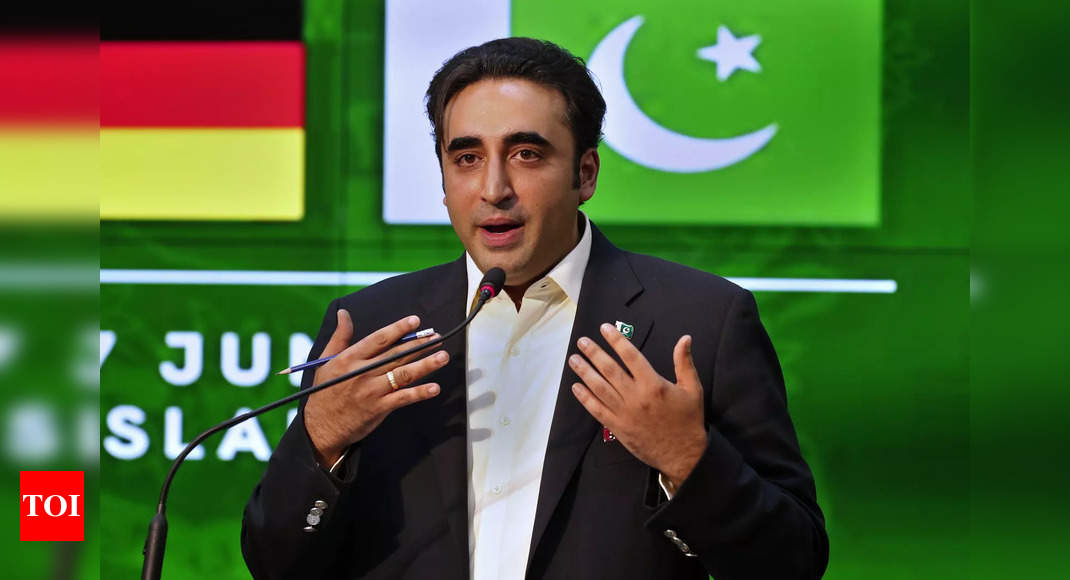
ISLAMABAD: Pakistan foreign minister Bilawal Bhutto Zardari stressed on engagement with India on Thursday, saying that it was the only way to influence policy-making in the neighbouring country.
“Does it serve our interests or do we achieve our objectives, whatever they may be, be it Kashmir, be it the rising Islamophobia, be it the Hindutva supremacist nature of the new regime and government in India? Does it serve our objective that we have practically cut all engagement,” Bilawal asked during his address at the Institute of Strategic Studies, an Islamabad-based think tank.
The FM said he believed that diplomatic, economical, cultural and political engagement was the only answer. “When I say that we’re cutting our nose to spite our face, I mean that if we’re not even going to try and engage on the basis of one issue or the other, then how can we hope to impact or change the course of events,” he asked, before narrating the list of issues that Pakistan has been raising against India time and again.
“Pakistan and India have a long history of war, conflict. Today, where we have serious disputes, the events of August 2019 cannot be taken lightly. The attempted undermining of the internationally disputed status of Kashmir, the beginning of a process to undermine the Muslim majority and artificially empower the minority are such important issues for us that indeed we have to take them up in the most serious and most aggressive manner,” he said.
“That I, as foreign minister of Pakistan, as the representative of my country, not only don’t speak to the Indian government but I also don’t speak to the Indian people — is that the best way to communicate or achieve Pakistan’s objective,” Bilawal asked.
He then referred to his slain mother former Pakistan PM Benazir Bhutto’s engagement with her Indian counterpart when she was first elected prime minister. “If at that point in time we had achieved economic engagement with India and our economic engagement on both sides had been to such a level that perhaps we would be in a position to more effectively influence Indian policy-making, that if India’s economic integration with Pakistan and Pakistan’s economic integration with India was at such a point, perhaps neither state would be in a position to take such extreme positions,” the minister said.
“Whatever I think about the government of India and their policies, and we have very strong feelings on that, if I’m talking at them through the media, through press conferences and press releases and statements and not talking with them, then am I able to effectively impact any sort of change,” he asked.
“…I don’t think (it) has ever happened in the history of the course of time and man that a state, even in times of war, has not communicated. Surely talking to the people and engaging with the public serves the interests of Pakistan,” he remarked.
“Does it serve our interests or do we achieve our objectives, whatever they may be, be it Kashmir, be it the rising Islamophobia, be it the Hindutva supremacist nature of the new regime and government in India? Does it serve our objective that we have practically cut all engagement,” Bilawal asked during his address at the Institute of Strategic Studies, an Islamabad-based think tank.
The FM said he believed that diplomatic, economical, cultural and political engagement was the only answer. “When I say that we’re cutting our nose to spite our face, I mean that if we’re not even going to try and engage on the basis of one issue or the other, then how can we hope to impact or change the course of events,” he asked, before narrating the list of issues that Pakistan has been raising against India time and again.
“Pakistan and India have a long history of war, conflict. Today, where we have serious disputes, the events of August 2019 cannot be taken lightly. The attempted undermining of the internationally disputed status of Kashmir, the beginning of a process to undermine the Muslim majority and artificially empower the minority are such important issues for us that indeed we have to take them up in the most serious and most aggressive manner,” he said.
“That I, as foreign minister of Pakistan, as the representative of my country, not only don’t speak to the Indian government but I also don’t speak to the Indian people — is that the best way to communicate or achieve Pakistan’s objective,” Bilawal asked.
He then referred to his slain mother former Pakistan PM Benazir Bhutto’s engagement with her Indian counterpart when she was first elected prime minister. “If at that point in time we had achieved economic engagement with India and our economic engagement on both sides had been to such a level that perhaps we would be in a position to more effectively influence Indian policy-making, that if India’s economic integration with Pakistan and Pakistan’s economic integration with India was at such a point, perhaps neither state would be in a position to take such extreme positions,” the minister said.
“Whatever I think about the government of India and their policies, and we have very strong feelings on that, if I’m talking at them through the media, through press conferences and press releases and statements and not talking with them, then am I able to effectively impact any sort of change,” he asked.
“…I don’t think (it) has ever happened in the history of the course of time and man that a state, even in times of war, has not communicated. Surely talking to the people and engaging with the public serves the interests of Pakistan,” he remarked.
[ad_2]
Source link