



[ad_1]
Road construction programmes that improve access increased the probability of an institutional delivery by 11-13 percentage points in India. However, there was no evidence that increased institutional deliveries improved rates of neonatal mortality or post-birth complications, whether the woman delivered in a public or private facility. These were the surprising findings of a study published in the British Medical Journal Global Health in July. It indicated that to reduce NMR or to improve maternal health outcomes, it was not sufficient to simply increase the proportion of women delivering in health facilities or in the presence of a skilled health provider. The study authors suggested that this may be because these facilities were not adequately staffed, trained, or equipped to deliver high-quality health services. They referred to several recent studies that found that even among the cadres of health workers defined as skilled, many did not provide sufficient clinical care, which could be an important barrier to improving clinical outcomes. The study correlated data on habitations/villages connected through the Pradhan Mantri Gram Sadak Yojana (PMGSY) from 2010 to 2015 with the data on health outcomes sourced from the 2015-16 District Health Survey. Its sample was restricted to women in rural areas who gave birth between December 2010 and March 2015,a total of 1,09,303 mothers and 1,59,570neonates (newborns). The road construction programme led to a larger increase in deliveries in public hospitals relative to other types of facilities, observed the study. In the study sample, 71. 2% of deliveries took place in public health facilities and only 15. 2% in a private hospital.
![Capture]()
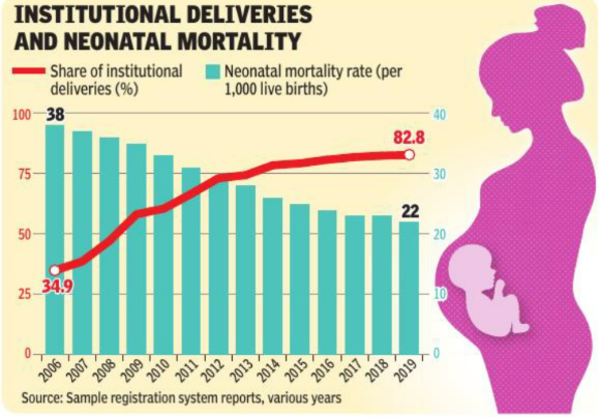
“The PMGSY was responsible for the observed increases in institutional deliveries in our sample and (this)was in keeping with the findings of other studies which have shown that distance and travel costs are important barriers to facility delivery, barriers that were minimised by PMGSY,” stated the study. It was also found that road upgrade was associated with an increase in the presence of a skilled birth attendant, doctors and nurses. A connected village appeared to benefit illiterate women the most, increasing the likelihood of institutional delivery among them by approximately 29 percentage points. This was followed by women who attained primary and secondary education, for whom the increase was around 24and 15 percentage points, respectively. Despite road connections pushing up the proportion of institutional deliveries, the study did not fi nd “any improvement in the neonatal or maternal health outcomes”.
Though delivery with a skilled attendant was strongly correlated with institutional delivery, prolonged delivery, and bleeding during delivery were more common among women who delivered in an institutional setting, noted the study. But the incidence of high fever post-delivery was higher among women who chose the home delivery setting.
The study confirmed what other studies in the context of low-middle income countries had demonstrated, that transportation is an important barrier to accessing health services. Distance to a facility and lack of transportation have been shown to be key inhibitors of health facility utilisation by pregnant women in rural India. A study in India from 2014 showed that each additional kilometre from the nearest health facility was associated with a 4. 4% decline in the probability of institutional delivery. Women in rural areas in India have been shown to pay twice as much as those in urban areas to travel to clinics to give birth.
The study called for more research to better understand why increased institutional deliveries and increased use of other maternal health services did not seem to translate into improvements in health outcomes contrary to the accepted wisdom.
[ad_2]
Source link